Sunday, April 27, 2014

Literature, War, and Abstract Language


From May 5th through the 11th, I will be in the gorgeous lakeside town of Bled, Slovenia, participating in a P.E.N. conference.  P.E.N. champions the abolition of censorship and the freeing of literary-political prisoners, of which there are twenty-eight in Cuba, say, and an uncountable number in China. Most of the proceedings, then, involve political strategizing.


There is always, however, another dimension of this conference. This year marks the 100th anniversary of WWI, and our theme will be “The Great War and Modern Literature.” As the American representative, I’m urged to speak of our own nation’s response to that calamity.

I’ll copy a version of my comments, but first the lucky back story of why I’m a participant.


In 2001, I was teaching in Lugano, Switzerland. A diplomat friend our family had known ten years before in Hungary. where I'd held a Fulbright fellowship invited us to stay at their Budapest home over Easter break and I’d give a tenth anniversary reading. The stay was delightful, and afterwards, our host said he’d spread the word to fellow diplomats that I would happily lecture or read elsewhere. I did visit several cities, including Ljubljana, the Slovene capital.


I joke that Slovenia is where right-acting poets go after death. I was in Slovenia’s national press, on its national TV, and most gratifying, on its public radio’s daily poetry program.


After the show, I had lunch with my interviewer, Marjan Strojan, when I learned he was not only an eminent poet himself but also the foremost Slovene translator of English poetry, having managed such modest projects as The Canterbury Tales, Paradise Lost, and Beowulf. But he claimed his greatest challenge had been the work of Robert Frost: Marjan always seeks form-true translation, but Slovenian is a language devoid of Frost’s signature iambic foot. For all that, he had managed fifty poems in half as many years, and they’d soon be published.


Marjan and I stayed in touch, and I soon got a sad note from him. His publisher had failed rightly to secure international rights to Frost’s canon, and Frost’s American publisher, Henry Holt, would exact a prohibitive permissions fee for any print run that exceeded 200. By pure chance, Frost’s literary executor is Peter Gilbert, a friend and former student, now director of the Vermont Humanities Council. So I forwarded Marjan’s email to him, along with my opinion that every single living Slovenian could buy Marjan’s book of translations without the least effect on Holt’s bottom line. Peter arranged the permission for a song.


For me this involved a quick email; for Marjan it redeemed a quarter-century’s work. In gratitude, he began to invite me back to all manner of literary events. Each time, he’d translate some of my poems, and in 2006 a selection of them appeared in print over there. Best of all, over time the translator has become one of my dearest friends. (Autumn Hill Press in Iowa, an excellent house specializing in eastern European authors, will soon publish a selection of his work here. Should you want to see a sample, go to http://wordswithoutborders.org/article/walking.)


Now my remarks, abridged, for the P.E.N. conference.


The Great War and the Death of Abstract Language


Ten decades ago, U.S. president Woodrow Wilson argued to a doubtful American populace that the country’s entry into war would “make the world safe for democracy.” Such idealistic rhetoric soon measured itself against brute fact: hundreds of thousands of war casualties and maimings.


The following, written by e.e. cummings after his Great War experience as an ambulance driver, makes much of such dissonance. It ironically echoes “My Country ‘Tis of Thee” , which nearly became our national anthem. The song begins, “My country, ‘tis of Thee,/Sweet land of liberty,” and goes on to salute the “Land where my fathers died,/Land of the pilgrims’ pride....”


“next to of course god america i
love you land of the pilgrims’ and so forth oh
say can you see by the dawn’s early my
country ’tis of centuries come and go
and are no more what of it we should worry
in every language even deafanddumb
thy sons acclaim your glorious name by gorry
by jingo by gee by gosh by gum
why talk of beauty what could be more beaut-
iful than these heroic happy dead
who rushed like lions to the roaring slaughter
they did not stop to think they died instead
then shall the voice of liberty be mute?”

He spoke. And drank rapidly a glass of water.


Artists have always been suspicious of conventional pieties, but the Great War deeply enhanced that suspicion. Cummings’s own anti-war suspicions were vocal enough to earn him a military incarceration and, eventually, to prompt a compelling novel, The Enormous Room. In the poem above, the clash of pietistic slogan with grim factuality is patent, and its demagogic protagonist seems to know it: he races through his address, reluctant to use his own jingoistic shibboleths. Unlike the hymn he quotes in part, the speaker avoids mentioning pride, for instance, and even if he makes an obligatory reference to God, as American politicians still seem obliged to do, he’s disinclined to say that his “country ‘tis of Thee.” At the end, we read, “He spoke. And drank rapidly a glass of water,” as though to wash the formulaic blather out of his mouth.


Cummings won’t ennoble rhetorical convention as a mark of patriotism, any more than he will consider poetic convention like the sonnet, which he at once adopts and mockingly subverts in this poem, as one of art. Even conventions of grammar and punctuation seem to offend him. No bromide, no propriety whatever– right, left, center, religious, atheistic– is simply to be accepted at face value.


There are examples of such skepticism and resistance throughout the work of American artists of the Great War. Given time constraints, I’ll refer only to Ernest Hemingway, another ambulance driver. He raises themes akin to Cummings’s, most famously in The Sun Also Rises, but really throughout his earlier work. One of his stories, “The Gambler, the Nun, and the Radio,” written in the lull between WWI and WWII, is exemplary.


The plot unfolds in a Catholic hospital, and involves a Mexican gambler, Cayetano, who has been shot in a small Montana town; a nun who aspires to be a saint; and Mr. Frazer, a writer recovering from a horseback accident, who constantly listens to his radio.


The nun invites three Mexican musicians to perform for Cayetano. One of them suggests that religion is the opium of the people, dulling them to their ignorance. After Frazer hears that opinion, he reflects as follows:


Religion is the opium of the people. He believed that, that dyspeptic little joint-keeper. Yes, and music is the opium of the people. Old mount-to-the-head hadn’t thought of that. And now economics is the opium of the people; along with patriotism the opium of the people in Italy and Germany. What about sexual intercourse; was that an opium of the people? Of some of the people. Of some of the best of the people. But drink was a sovereign opium of the people, oh, an excellent opium. Although some prefer the radio, another opium of the people, a cheap one he had just been using. Along with these went gambling, an opium of the people if there ever was one, one of the oldest. Ambition was another, an opium of the people, along with a belief in any new form of government. What you wanted was the minimum of government, always less government. Liberty, what we believed in, now the name of a MacFadden publication (i.e. a tabloid).


Though Frazer makes no direct reference to the Great War, its effects show themselves here: like Cummings, he stresses

the emptiness of abstractions like Liberty. And yet, half-addled by drugs and drink and pain, he

speaks as follows:


“Listen,” Mr. Frazer said to the nurse when she came. “Get that little thin Mexican in here, will you, please?”

“How do you like it?” the Mexican said at the door.

“Very much.”

“It is a historic tune,” the Mexican said. “It is the tune of the real revolution.”

“Listen,” said Mr. Frazer. “Why should the people be operated on without an anæsthetic?”

“I do not understand.”

“Why are not all the opiums of the people good? What do you want to do with the people?”

“They should be rescued from ignorance.”

“Don’t talk nonsense. Education is an opium of the people. You ought to know that. You’ve had a little.”

“You do not believe in education?”

“No,” said Mr. Frazer. “In knowledge, yes.


In distinguishing education from knowledge, I believe Hemingway smells danger in thought removed from tangible, empirical reference. Such thought is, so to speak, disembodied speech; it’s abstract in the Latin sense, “a drawing away.” The wounded and dying are unlikely to recite dulce et decorum est pro patria mori. The anodynes we propose to soothe us in a world as cruel as late history has proven– perhaps all are empty; but the broad political ones, which have so deceived and wounded “the people,” are downright disastrous. We all may deceive ourselves; but let us at least be modest in our self-deceptions.


The constitutional skepticism that I mentioned at the outset, has by our time solidified itself among American artists; but, tragically, it has not spread among the truly powerful. I can think of no U.S. poet, for instance, who endorsed George W. Bush’s unconscionable 2003 misadventure, code-named– what else?– Iraqi Freedom. And yet that murderous and foolish campaign went forward. Bush spoke of an “axis of evil.” He had not, one assumes, ever encountered the counsel of Ezra Pound (before Pound himself went politically insane): Go in fear of abstractions.


Yes, I wince in my own time to hear billowy, abstract rhetoric in the mouths of politicians. Iraqi Freedom indeed. I can read the news and see what that freedom amounts to even now. I wish, however, that the problem were a partisan one. Today, however, with a supposedly liberal administration in office, one often hears from high places terms like human dignity– even as our drones wipe out untold hundreds of invisible lives.


That last example is germane. Our abstractions, our disembodiments, can so easily lead us to dehumanization,, especially, I believe, in a virtual world. Assisted by technology, our power-brokers can all too easily divorce themselves from Hemingway’s brand of “knowledge,” even to the point of forgetting that the enemy dead, civilian and “terrorist” alike, were ever living, breathing people.


Let me here make a leap to consider some ramifications of all this for the writer. Since the advent of deconstruction in literary study, a parallel danger emerges, at least in my opinion. That so-called literary theory should have stressed the inevitable disjunction between what we always thought was signification and its intended object; that it should have found language to be an unavoidable artifice: these were perhaps important propositions, and surely ratified those suspicions that artists have always held of official language. Theory may have helped discredit propaganda. But if we follow many of its premises to their furthest conclusions, every ideal becomes at worst a lie and at best a distortion. If that be the case, then there can be no solid reason for honorable thought or activity. “It is easy to be brilliant if you do not believe in anything,” as Goethe said. If there is no such thing as truth, how may we censure students who go on to join America’s corporate elite?


Mark Edmundsen, a maverick professor at my own alma mater, Yale, puts the matter thus:


If the business of education as de-idealization had ended with the revelations     about de Man’s wartime anti-Semitism  or Derrida’s death, then all this would be semi-ancient history. But it’s not over. Universities made a turn toward  the de-Bunkers, and they’ve not turned back. Scholars don’t take ideals too seriously; academics remain pretty much in the de-divinization business, which is the business of deflating or attacking ideals. Few professors in my field, literature, believe that they can distinguish rigorously between pop-culture flotsam and the works of Milton. Few of them know how to mount an argument that values Wyatt’s poetry over a video game. Few believe that reading the best that has been thought and said can give a young person something to live for and teach him or her how to live.


So where, as humanists, can we stand? Have we no choice beside empty, even ruinous, Wilsonian idealism on the one hand and a skepticism so deep on the other as to amount, essentially, to mere cynicism? As so often, I think, it is the practitioners of our art rather than its critics and scholars who may show us a way. Let me close with a poem by Robert Hass, a former poet laureate of my country:


                       Meditation at Lagunitas


              All the new thinking is about loss.

              In this it resembles all the old thinking.

              The idea, for example, that each particular erases

              the luminous clarity of a general idea. That the clown-

              faced woodpecker probing the dead sculpted trunk

              of that black birch is, by his presence,

              some tragic falling off from a first world

              of undivided light. Or the other notion that,

              because there is in this world no one thing

              to which the bramble of blackberry corresponds,

              a word is elegy to what it signifies.

              We talked about it late last night and in the voice

              of my friend, there was a thin wire of grief, a tone

              almost querulous. After a while I understood that,

              talking this way, everything dissolves: justice,

              pine, hair, woman, you and I. There was a woman

              I made love to and I remembered how, holding

              her small shoulders in my hands sometimes,

              I felt a violent wonder at her presence

              like a thirst for salt, for my childhood river

              with its island willows, silly music from the pleasure boat,

              muddy places where we caught the little orange-silver fish

              called pumpkinseed. It hardly had to do with her.

              Longing, we say, because desire is full

              of endless distances. I must have been the same to her.

              But I remember so much, the way her hands dismantled bread,

              the thing her father said that hurt her, what

              she dreamed. There are moments when the body is as numinous

              as words, days that are the good flesh continuing.

              Such tenderness, those afternoons and evenings,

                   saying blackberry, blackberry, blackberry.


I believe that, as writers and thinkers and simple citizens, we must hold the feet of our powerful to the fire. We must demand that their abstractions be tethered to what Eliot called their objective correlatives, that they be grounded in the flesh-and-blood realities not only of their own constituencies but also of the world’s citizenry, that they be founded on a Hemingwayesque “knowledge.”


As Hass’s poem implies, there may be no way for language to get at ultimate truths. But let us speak of what we can know; let us speak of provisional truths. The slipperiness of language, so ably demonstrated by the deconstructionists and their successors, ought not lead us to nihilism. Hass’s poem is instructive, urging us, rather, to humility– which, as I’m fond of repeating, never hurt anyone.


Tuesday, April 15, 2014

Slow Down


In the two years since I became Vermont’s state poet, I have written some forty monthly newspaper columns. I have received innumerable responses, most of them blessedly supportive. (There have been just a few of the other kind.) Of all these, perhaps the most welcome came in reaction to my last effort. Part of the letter read as follows: “I had been away for many days and so I was quickly filling up my morning with busy tasks...I spotted your column– and my day changed... My mind slowed down, and life to me took on the right perspective again.”

Who could ask for a kinder appreciation? But recalling the skeptic in Luke’s gospel, I instantly thought, “Physician, heal thyself.”

That kind letter, you see, reached me after I too had been away for many days, on a delightful visit with a west coast friend of almost fifty years, and like my correspondent, it seems, I behave strangely after being off somewhere, even briefly: I worry that everything must be done yesterday, because I have been neglectful.

Neglectful of what? I have been retired for two years now.

But old habits die hard. And, because April is National Poetry Month, I did return to a whole series of scheduled appearances. In the past ten days, I’ve had nine such obligations, which involved successive, back-to-back round trips of four hours. After a one-day interlude, similar back-to-backs come on as of tonight.

These appearances, of course, do not constitute work. If I’m to read, the work has already been done (and it’s best described anyhow as work, not labor). Likewise if I’m to visit a library to speak about poetry: after some ninety such visits I need not “prepare,” just show up and enjoy the people I meet.

The letter I mentioned, together with my own idiotic anxiety and hurry, got me to thinking about the ways in which poetry is, or should be, related to slowing down, and how such slowing down may relate to what that letter called a right perspective.

In 1991, former U.S. Poet Laureate Mark Strand contributed an essay to the New York Times. It was aptly called “Slow Down for Poetry,” and it indicated, better than I will here, that poetry asks us to eschew the pace of typical contemporary life, because we can’t take in a poem’s particular qualities at the same speed with which, via technology, we more and more receive information.  We can’t rush through it as we may through website pages.  No, to absorb poetry, we must contemplate line, sentence, stanza, image, metaphor, and so on. We must, as a rule, re-read. We must, that is, slow down.

Permit me an apparent detour. Last night, my wife and I had a restaurant date. We try to schedule one every week if we can. (I almost said “if time allows.”) The place we chose has a charming ambience, a professional and cordial staff, excellent food. As soon as we were seated, though, I beheld something that in our time is a commonplace. At a table near to ours sat a family of four, from whom we detected precious little conversational buzz– because for most of the meal, all its members were glued to their Smart Phones. Could anything short of natural disaster or someone’s health crisis, I wondered, be so urgent that these people couldn’t savor what was served them, and more importantly, each other’s company?

As a writer, I have over and over again –sometimes, granted, at risk to practical obligations– experienced so profound a meditation on my own language and on all that it starts in my soul that I’ve suddenly looked at my watch and been stunned: what I’d believed mere minutes at my task turned out to be hours! I have, as the saying goes, lost all sense of time. 

Now it’s not that everyone needs to be a poet, not at all. Nor is poetry the only mode of entering that unclocked sphere. But it is one way.

I try hard not to moralize, because I have plenty of defects; I am no better than the next man or woman. And yet I worry that for our culture knowledge has in fact been confused with the accumulation of data, and that we are so bound by our hell-for-leather virtual world that we miss the non-virtual. How often, for instance, have I seen kids intent on some device’s screen as they sit in the backseat of a car that passes through our Green Mountains or along some jewel-like lake’s shore? I want to scream, LOOK UP! How shocked I was, too, on one recent occasion to hear a highly remunerated software engineer ask at just what point George Washington was U.S. president.

That engineer would have said, perhaps, and rightly, that every sort of information is now accessible with a touch on a keyboard. I won’t be hypocrite enough, either, to say that I don’t take advantage of that access, and of course this and all my posts rely on technology. But information and knowledge are not identical quantities, nor are data and a vision of our world.

I’m given to quoting from my greatest predecessor as Vermont’s state poet, and it seems to me the following remarks are deeply related to what I am insisting on here:

Anyone who has achieved the least form to be sure of it, is lost to the larger excruciations. I think it must stroke faith the right way. The artist, the poet, might be expected to be the most aware of such assurance. But it is really everybody's sanity to feel it and live by it. Fortunately, too,  no forms are more engrossing, gratifying, comforting, staying than those lesser ones we throw off, like vortex rings of smoke, all our  individual enterprise and needing nobody's cooperation; a basket, a letter, a garden, a room, an idea, a picture, a poem.

Frost may seem to knock poetry off its putative pedestal by likening it, say, to a letter. Be that as it may, the great man’s message is clear, and it is implicit, precisely, in the sentiments voiced by the maker of the letter I cited at the outset. “Everybody’s sanity,” I believe, including my own, depends on slowing down. Poems can help if you are inclined that way.


Monday, April 14, 2014

Revision and Extension

Some time ago, I posted a poem here, which is now the opening section of a three-poem suite, as follows:


Who Knows? That Lifelong question


i. He Risks a Walk 

Between two pock-marked beech,  on a strand of wire 
For cows he recalls from childhood, the cruel barbs shine,
Blossoms of brightness. When darkness stoops, Orion
Will shine likewise, as always, among the stars.
He’ll nock his arrow, as if to kindle mayhem
Below.  For now, the old man thinks of the house,
Where his wife must still feel disquiet. The weather scared them
Last night with sideways rain, which in due course froze.
When he all but trips on a winter-kill, he wonders,
Has he read somewhere of a people who buried their dead
As the grouse in his path is buried, neck and head 
Alone protruding, or was that just some old torture?
The grouse’s stiffened ruff is lustrous with frost.

The bird had hidden in powder. When it turned to ice,
It sealed the body in. So peculiar a sight
Has stopped the old man cold in this foolish walk.
Today’s no day for wandering under trees
Going off around him everywhere, loud as guns–
The clap and crack of bursting limbs and trunks.
Sunbeams garland the forest in silvery beads,
Every branch and bole, both shattered and whole,
A radiant filament.  He can’t see why
Death looks so brilliant. Its dead eyes rimed and white,
The head might be a flower, or maybe a jewel
Carelessly dropped by somebody roaming here
Where the walker feels his way, the trail so sheer.


ii. He Walks and Stops

His trail so sheer, his knees not what they were,
The walker finds himself
Pausing more often than stepping, and in these lulls–
Although he’s tired of memory,
Damnable habit that’s been the stuff of his life–
The past creeps up again.

He muses how it’s the biggest surprise he’s known:
The fact that he’s gotten old,
That, for example, he’s forced to put a hand
On each of those cobbly knees
And push down hard whenever he needs to step up
Onto even slight swells or rock-forms.

It’s what he did, he recalls, on grammar-school stairs,
And then, in adolescence,
Went on to mock the younger boys for doing. 
He sees those small ones still,
Their untucked shirts and trousers and untied shoes
Gone muddy out on the playground,

As they pant on the steps, their little mouths agape,
The dread, imperious bell
Reminds them that they’re late again. They’re late.
The old man also sees
In this red oak grove a few stumps here and there
Of long-gone trees he hewed

Forty years back or more, their wood turned dozey,
Such that he all but pictures
Their turning to air itself were he to kick them,
Although of course he won’t,
For fear of losing balance. Imagination,
Vision – it’s all he has,

It seems, by which he means the ceaseless function
Of selective memory.
He thinks of war in Syria now, for instance,
And thinks he ought to be thinking
Of that, or of any news his mother described
In his boyhood as “current events,”
Rebuking his idle dreaming. He hears her voice
To this day and can’t gainsay it.
Three cord in eight short hours: that’s what he’d fell
And cut and split and stack.
Why shouldn’t he still be strong? Another surprise.
He walks on fifty feet

And pauses once again. A random gust
Blows in a scent of winter.
He can’t identify it, although it’s familiar:
He’s taken this odor in
For seven decades, but now he wants to ignore it.
He’d rather not be mired

For even a moment in even the least old question.
Yet how does one look ahead
Or out from here? The prospect appears absurd.
For all of that, he notes
The buds of February tending to purple
The way they’ve always done, 

And he can’t help it: he has to conjure spring.
He can’t resist somehow.
Is this mere habit too, or might it be
An authentic sense of revival?
He walks a while again and stops again,
Walks on and doesn’t know.


iii. He’ll Stay With That

He doesn’t know as he walks,
That two coyotes are mating
Within yards of where he passes,
In that late-growth fir clump northward.

He knows only enough to imagine
They’re there. If he passes again
In eight weeks or so, the bitch–
Will howl, if she exists.

She’ll be guarding her whelps from the walker
Unless or until he moves on.
If she feels fear, she’ll hide it.
Ice out on the river

Will have loosened up its suction
To either shore, and he 
May not witness this either. Who knows?
Who knows? That lifelong question.

He tries not to prophesy
What constitutes his future,
Quietly urging himself instead
To consider what little he can know,

Or at least can see: for instance,
These tiny, wriggling specks
In the granular stuff under trees:
Snow fleas, harbingers

Of the sugar maker’s season.
Perhaps he’ll stay with that,
Will end with sweet figuration
As home rises into sight.


Thursday, April 10, 2014

Sorry for the silence

Dear Readers,

I was in California in late March and early April, and when I returned, I confronted some technical glitches with my blog. These are still being worked out. I hope to have some new thoughts up and readable in the very near future.

Wednesday, March 5, 2014

homage to a north country poet– and some north country reflections

Somewhat belatedly, I want to add my voice to the rightful chorus of tribute to the late Maxine Kumin. She lived about an hour and a half to my southeast, and I knew and admired and greatly liked this marvelous woman for nigh on 40 years. 

To my mind, she was for at least that many decades the premier poet of upper New England (not to slight the likes of Ellen Voigt or Wesley McNair, each a giant, to be sure).  

This is scarcely to reduce Maxine's work to mere regionalism. She was regional only in the sense that Frost was: her gimlet eye for local detail and character –both human and beastly– provided her with a deeply rooted perspective on the world at large, including the political world, which in later years angered her enough to impel some truly feisty, and truly excellent, poems on the political realm.

One has to think of someone like Robert Penn Warren to indicate a writer who, like Maxine, turned out some of her very best work, which is to say something indeed, well into her eighties. (I give one example among scores just below.)

For my part, I shall miss Maxine– a lot; but the world of letters will feel her absence even more acutely.

RIP, great soul.


JACK

How pleasant the yellow butter
melting on white kernels, the meniscus
of red wine that coats the insides of our goblets

where we sit with sturdy friends as old as we are
after shucking the garden's last Silver Queen
and setting husks and stalks aside for the horses

the last two of our lives, still noble to look upon:
our first foal, now a bossy mare of 28
which calibrates to 84 in people years

and my chestnut gelding, not exactly a youngster
at 22. Every year, the end of summer
lazy and golden, invites grief and regret:

suddenly it's 1980, winter buffets us,
winds strike like cruelty out of Dickens. Somehow
we have seven horses for six stalls. One of them,

a big-nosed roan gelding, calm as a president's portrait
lives in the rectangle that leads to the stalls. We call it
the motel lobby. Wise old campaigner, he dunks his

hay in the water bucket to soften it, then visits the others
who hang their heads over their dutch doors. Sometimes
he sprawls out flat to nap in his commodious quarters.

That spring, in the bustle of grooming
and riding and shoeing, I remember I let him go
to a neighbor I thought was a friend, and the following

fall she sold him down the river. I meant to
but never did go looking for him, to buy him back
and now my old guilt is flooding this twilit table

my guilt is ghosting the candles that pale us to skeletons
the ones we must all become in an as yet unspecified order.
Oh Jack, tethered in what rough stall alone

did you remember that one good winter?


***********************************************
What follows is a rumination that may itself seem rather lococentric, and yet, I hope, as with Maxine's work, that it raises issues –not that it resolves them at all– which can resonate all over our nation, even across the world at large.


My wife and I own a cabin in Maine. I bought it for $500 some forty years back, because its neighborhood is spectacular. The place sits, however, in the poorest county in the northeastern U.S. Since the economic meltdown of six years past, that poverty shows more plainly than ever: abandoned farms, houses, and even tarpaper shacks for sale, items of little value by the roadside, marked with scanty prices. On our way to the cabin in the dead of a polar vortex winter, I winced as always to pass a canted school bus next to route 6; I vaguely know the man who lives in it year-round.


During our stay, such desperation weighed on our minds, subtly chewing at our peace and coziness. I tried to solace myself by thinking I’d done some small good as president of a local land trust, whose mission is not simply to set aside forests and waters for conservation’s sake but also to provide some sustainable forestry jobs in a zone where employment of any kind is hard to come by. Still, a hellish lot of people are hungry in that county, a fair number of them breaking game laws by way of survival: while we were at our cabin, a whole family was arrested for killing a cow moose out of season. They had their reasons.


Maine is one of the three hungriest states in the nation, but Vermont is in the top ten too. Awareness of such statistics kept eating at us, perhaps especially because of the season’s bitter cold, and got me to thinking about people who pass through upper New England, perhaps to ski or for some picturesque wedding, and who imagine they behold a rural Eden. Unfortunately that view is not uncommon among many who live in the north country too. How frequently does one enter a restaurant or a B&B hereabouts and find some claim that the place recalls “a time when life was simple”?


When was that time? After all, the sort of poverty I’m reflecting on proved more or less commonplace in our region back in those allegedly simple times. One can find reference to it throughout the work of our first state poet, as I’ll indicate directly. A time when life was simple? It wasn’t back then, and for too many it’s not that now. The various food banks that many of us support are more than worthy institutions; but mustn’t we now and then wonder why they remain so vitally needful?


Those who construe the north country as a place of simple peace and comfort need to travel over the ridges and look on their other sides. I am no saint, no Mother Tersesa, but I have witnessed some grim struggles over there. I began as a tutor for Central Vermont Adult Basic Education, whose board I now chair, and I’ve seen the bitter complication of certain lives in such a capacity. Moreover, and perhaps strangely, even offensively, to some, my lifelong hunting enthusiasms, while not matters of survival, of course, have led me into the company of many for whom they were and are. Their perspective on the north country is a lot less quaint than the complacent one I refer to– and for understandable reasons.


A little detour: The Robert Frost Place in Franconia, New Hampshire, where the great author lived from 1915 to 1920, sponsors a resident poet every summer. In 1977, it was Robert Hass, who two decades later would be U.S. Poet Laureate. I went to visit Bob during his stay, and he repeated a story told to him by an elderly lady down the road from Frost’s house. The woman had long left Franconia, but she’d been born in the village, and had spent  summers helping her grandparents, who farmed the land abutting Frost’s. Early in Frost’s tenure, she and her grandfather were riding his wagon to town when they saw the poet sitting on his porch.


“Grandpa,” the little girl asked, “who’s that man who bought Joe Hebert’s farm?”


The old farmer replied, “That is the laziest, most good-for-nothing person who ever moved to Franconia. All he does is sit in that chair and write letters. Come winter, he’ll be down in the village and we’ll all be paying for him.”


The story is amusing, but it speaks to a time –and maybe it was simpler in this one regard– when towns in our part of New England were obliged to provide for citizens who could not do so for themselves. In my own memory, Vermont had Overseers of the Poor, who were charged with seeing to this. There were also poor farms, the last dying in the 1960s, where the indigent could labor for sustenance. There is a famous, early-1800s court case involving a Vermont judge who owned an African-American slave. She’d toiled for him all her working life, but when she became old and disabled, the judge felt the town should look after her. He had to recuse himself from the final Supreme Court decision, which went his way, as I recall, because he was in fact Chief Justice (simpler times, you see).


Now I despise cartoon politics, left or right, the sort of rhetoric that offers pat, blanket solutions to major social problems like the one I describe. I’m not going to point any fingers in this column, and Lord knows that no poetry worth its salt would ever engage in simplism either, political or otherwise. But a poem like Frost’s own “An Old Man’s Winter Night” offers a dark comment on cavalier notions of Emersonian self-reliance among the indigent. I haven’t room to quote it here, but if you look it up, you will find the world’s loneliest poem.


What poetry can do, at least, is to remind us how our morals are taxed every day, if our eyes are open. Or it can open them. No, I have no right to play saint or sage, drawn like anyone as I am to comfort and to clan, and helpless as the next person to construe just societal solutions. But poetry, or at any rate poetry as keenly attentive as our first state poet’s, can remind us of an ongoing history, which still includes too much misery and want, and of our own inclination to dismiss or rationalize it for our own benefit.  We should at a minimum be asking questions of ourselves:


                         Love and a Question


A Stranger came to the door at eve,

   And he spoke the bridegroom fair.

He bore a green-white stick in his hand,

   And, for all burden, care.

He asked with the eyes more than the lips

   For a shelter for the night,

And he turned and looked at the road afar

   Without a window light.


The bridegroom came forth into the porch

   With, ‘Let us look at the sky,

And question what of the night to be,

   Stranger, you and I.’

The woodbine leaves littered the yard,

   The woodbine berries were blue,

Autumn, yes, winter was in the wind;

   ‘Stranger, I wish I knew.’


Within, the bride in the dusk alone

   Bent over the open fire,

Her face rose-red with the glowing coal

   And the thought of the heart’s desire.

The bridegroom looked at the weary road,

   Yet saw but her within,

And wished her heart in a case of gold

   And pinned with a silver pin.


The bridegroom thought it little to give

   A dole of bread, a purse,

A heartfelt prayer for the poor of God,

   Or for the rich a curse;

But whether or not a man was asked

   To mar the love of two

By harboring woe in the bridal house,

   The bridegroom wished he knew.


How pleasant the yellow butter melting on white kernels, the meniscus of red wine that coats the insides of our goblets where we sit with sturdy friends as old as we are after shucking the garden's last Silver Queen and setting husks and stalks aside for the horses the last two of our lives, still noble to look upon: our first foal, now a bossy mare of 28 which calibrates to 84 in people years and my chestnut gelding, not exactly a youngster at 22. Every year, the end of summer lazy and golden, invites grief and regret: suddenly it's 1980, winter buffets us, winds strike like cruelty out of Dickens. Somehow we have seven horses for six stalls. One of them, a big-nosed roan gelding, calm as a president's portrait lives in the rectangle that leads to the stalls. We call it the motel lobby. Wise old campaigner, he dunks his hay in the water bucket to soften it, then visits the others who hang their heads over their dutch doors. Sometimes he sprawls out flat to nap in his commodious quarters. That spring, in the bustle of grooming and riding and shoeing, I remember I let him go to a neighbor I thought was a friend, and the following fall she sold him down the river. I meant to but never did go looking for him, to buy him back and now my old guilt is flooding this twilit table my guilt is ghosting the candles that pale us to skeletons the ones we must all become in an as yet unspecified order. Oh Jack, tethered in what rough stall alone did you remember that one good winter? - See more at: http://www.poets.org/viewmedia.php/prmMID/16926#sthash.YAOR2Ghd.dpuf

Jack

  by Maxine Kumin
How pleasant the yellow butter
melting on white kernels, the meniscus
of red wine that coats the insides of our goblets

where we sit with sturdy friends as old as we are
after shucking the garden's last Silver Queen
and setting husks and stalks aside for the horses

the last two of our lives, still noble to look upon:
our first foal, now a bossy mare of 28
which calibrates to 84 in people years

and my chestnut gelding, not exactly a youngster 
at 22. Every year, the end of summer
lazy and golden, invites grief and regret:

suddenly it's 1980, winter buffets us, 
winds strike like cruelty out of Dickens. Somehow
we have seven horses for six stalls. One of them,

a big-nosed roan gelding, calm as a president's portrait
lives in the rectangle that leads to the stalls. We call it
the motel lobby. Wise old campaigner, he dunks his

hay in the water bucket to soften it, then visits the others
who hang their heads over their dutch doors. Sometimes 
he sprawls out flat to nap in his commodious quarters.

That spring, in the bustle of grooming
and riding and shoeing, I remember I let him go
to a neighbor I thought was a friend, and the following 

fall she sold him down the river. I meant to
but never did go looking for him, to buy him back
and now my old guilt is flooding this twilit table

my guilt is ghosting the candles that pale us to skeletons
the ones we must all become in an as yet unspecified order. 
Oh Jack, tethered in what rough stall alone

did you remember that one good winter?
- See more at: http://www.poets.org/viewmedia.php/prmMID/16926#sthash.7N7qFGpM.dpuf

Jack

  by Maxine Kumin
How pleasant the yellow butter
melting on white kernels, the meniscus
of red wine that coats the insides of our goblets

where we sit with sturdy friends as old as we are
after shucking the garden's last Silver Queen
and setting husks and stalks aside for the horses

the last two of our lives, still noble to look upon:
our first foal, now a bossy mare of 28
which calibrates to 84 in people years

and my chestnut gelding, not exactly a youngster 
at 22. Every year, the end of summer
lazy and golden, invites grief and regret:

suddenly it's 1980, winter buffets us, 
winds strike like cruelty out of Dickens. Somehow
we have seven horses for six stalls. One of them,

a big-nosed roan gelding, calm as a president's portrait
lives in the rectangle that leads to the stalls. We call it
the motel lobby. Wise old campaigner, he dunks his

hay in the water bucket to soften it, then visits the others
who hang their heads over their dutch doors. Sometimes 
he sprawls out flat to nap in his commodious quarters.

That spring, in the bustle of grooming
and riding and shoeing, I remember I let him go
to a neighbor I thought was a friend, and the following 

fall she sold him down the river. I meant to
but never did go looking for him, to buy him back
and now my old guilt is flooding this twilit table

my guilt is ghosting the candles that pale us to skeletons
the ones we must all become in an as yet unspecified order. 
Oh Jack, tethered in what rough stall alone

did you remember that one good winter?
- See more at: http://www.poets.org/viewmedia.php/prmMID/16926#sthash.7N7qFGpM.dpuf

Thursday, February 20, 2014

Visit to Warrensburg MO and KC

Just a shout-out here to Wayne Miller, the editors of PLEIADES magazine, and all I met during this recent reading trip to the University of  Central Missouri. The food in KC is enough on its own to justify such a journey, but my conversations with Wayne, with his charming wife Jeanne, with PLEIADES founding editor Rose Marie Kinder, with U of M/KC poet Michelle Boisseau, with UCM writing faculty members Phong Nguyen and Kate Nuernberger– all those encounters steel me in my long-held conviction that a lot, if not most, of the brains and talent in my world exist in places that certain Ivied snobs and east- or west- coast chauvinists might archly describe as the provinces.

What a lively scene I walked into out there! I am grateful beyond description.

It felt timely too to be in KC just as I was finishing KANSAS CITY LIGHTNING, Stanley Crouch's much lauded book on native son Charlie Parker. I wish I thought better of that volume myself. Crouch is obviously a learned, passionate, and very bright man; but I'm constantly put off by his --what?-- "novelistic" strategies in the account of Bird's early career. He seems able, for example, to know just how Parker's first wife, Rebecca, felt upon seeing Charlie at the beginning. He knows that she had goose bumps, and knows just what was running through her mind. Touches like this, and they abound throughout, detract from his portrayal of one of American music's most gifted,compelling, and troubled figures. One can't, or at least I can't, keep from shouting out loud: How in hell can you know that, looking back from well into the 21st century? I long to suspend disbelief, but I'm simply unable.

Tuesday, February 11, 2014

double laureate team-up

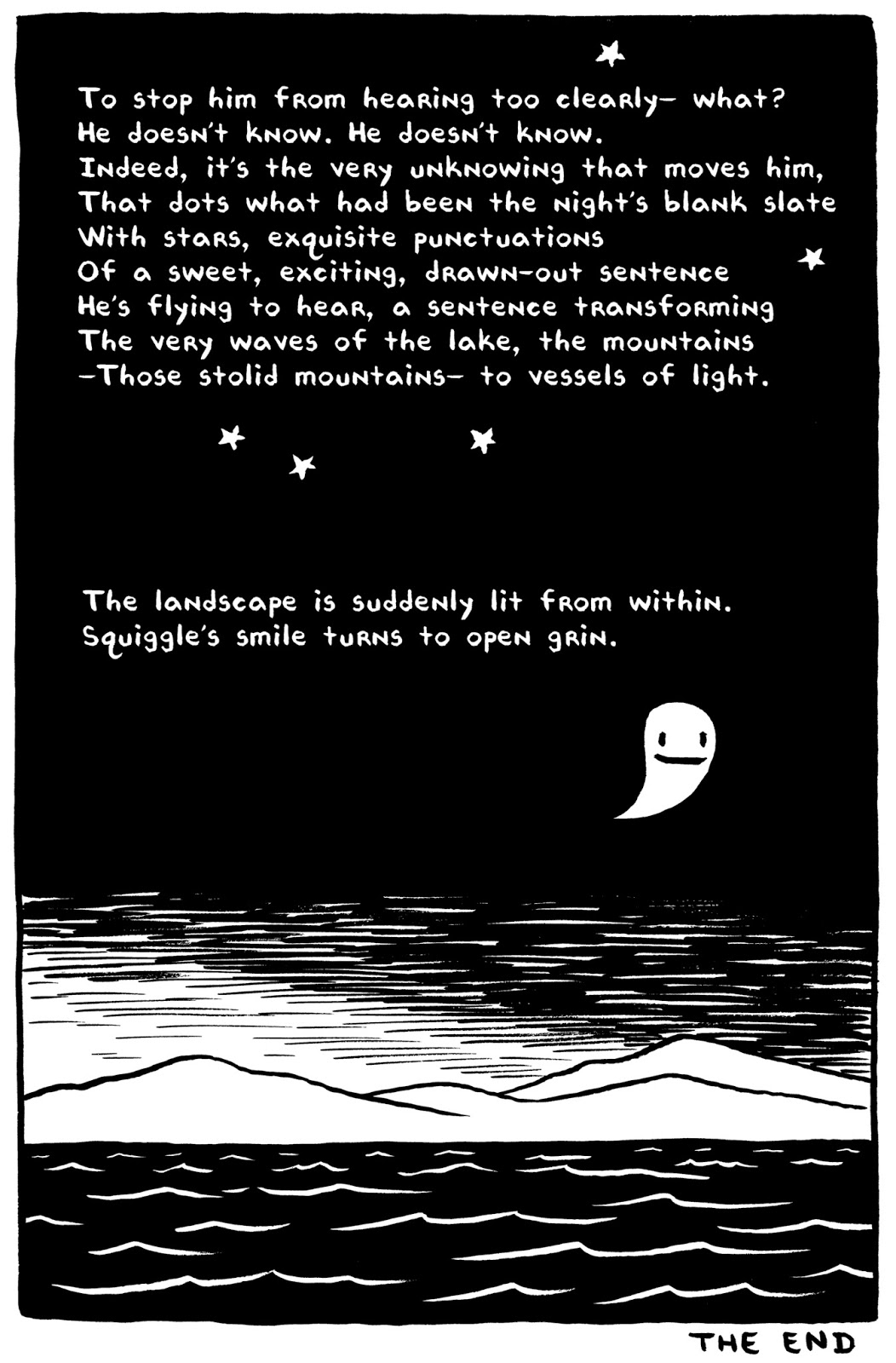
A while ago, the fabulously talented and bright Vermont Cartoonist Laureate James Kochalka (since succeeded by Ed Koren) collaborated with me on a book of– what? Graphic poetry? Sure, why not?

First, James drew cartoon illustrations of a poem by my hand, "Garnett and Leon in December," reproduced below. (You may have to use your Zoom command to read the text.)


Then he sent me four uncaptioned panels, featuring a strange little character named Squiggle, and I composed a poem in response, also reproduced below.


I'd never have dreamed that such a collaboration –sponsored by the Vermont Arts Council and the Vermont Center for Cartoon Studies– would eventuate. I am very glad it did!