Just a shout-out here to Wayne Miller, the editors of PLEIADES magazine, and all I met during this recent reading trip to the University of Central Missouri. The food in KC is enough on its own to justify such a journey, but my conversations with Wayne, with his charming wife Jeanne, with PLEIADES founding editor Rose Marie Kinder, with U of M/KC poet Michelle Boisseau, with UCM writing faculty members Phong Nguyen and Kate Nuernberger– all those encounters steel me in my long-held conviction that a lot, if not most, of the brains and talent in my world exist in places that certain Ivied snobs and east- or west- coast chauvinists might archly describe as the provinces.
What a lively scene I walked into out there! I am grateful beyond description.
It felt timely too to be in KC just as I was finishing KANSAS CITY LIGHTNING, Stanley Crouch's much lauded book on native son Charlie Parker. I wish I thought better of that volume myself. Crouch is obviously a learned, passionate, and very bright man; but I'm constantly put off by his --what?-- "novelistic" strategies in the account of Bird's early career. He seems able, for example, to know just how Parker's first wife, Rebecca, felt upon seeing Charlie at the beginning. He knows that she had goose bumps, and knows just what was running through her mind. Touches like this, and they abound throughout, detract from his portrayal of one of American music's most gifted,compelling, and troubled figures. One can't, or at least I can't, keep from shouting out loud: How in hell can you know that, looking back from well into the 21st century? I long to suspend disbelief, but I'm simply unable.
Thursday, February 20, 2014

Tuesday, February 11, 2014
double laureate team-up
A while ago, the fabulously talented and bright Vermont Cartoonist Laureate James Kochalka (since succeeded by Ed Koren) collaborated with me on a book of– what? Graphic poetry? Sure, why not?
First, James drew cartoon illustrations of a poem by my hand, "Garnett and Leon in December," reproduced below. (You may have to use your Zoom command to read the text.)


Then he sent me four uncaptioned panels, featuring a strange little character named Squiggle, and I composed a poem in response, also reproduced below.


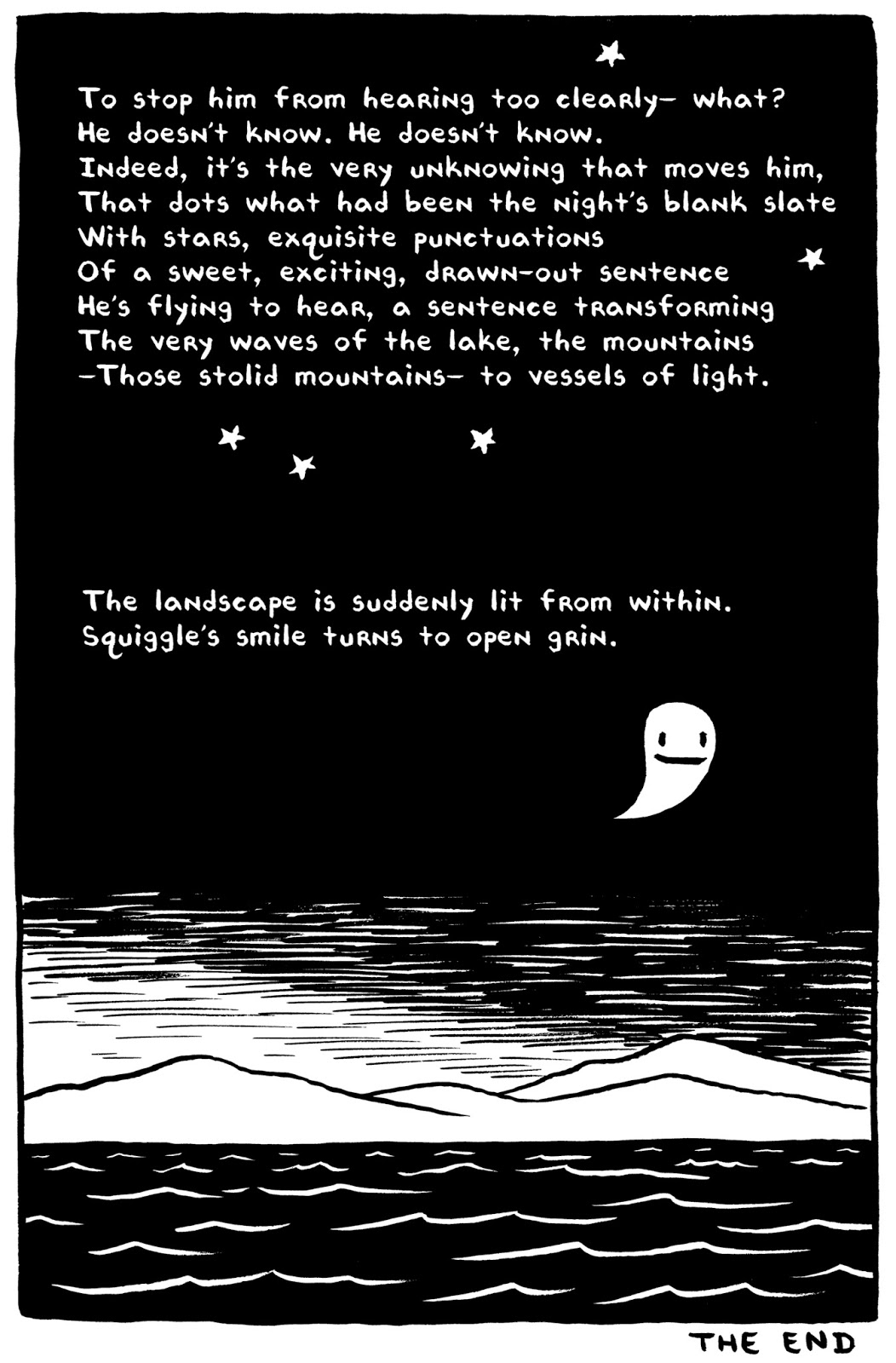
I'd never have dreamed that such a collaboration –sponsored by the Vermont Arts Council and the Vermont Center for Cartoon Studies– would eventuate. I am very glad it did!
First, James drew cartoon illustrations of a poem by my hand, "Garnett and Leon in December," reproduced below. (You may have to use your Zoom command to read the text.)
Then he sent me four uncaptioned panels, featuring a strange little character named Squiggle, and I composed a poem in response, also reproduced below.
I'd never have dreamed that such a collaboration –sponsored by the Vermont Arts Council and the Vermont Center for Cartoon Studies– would eventuate. I am very glad it did!
Wednesday, January 29, 2014
Two New Poems
After the holidays, and after the funeral of my wife's wonderful brother, to whom I referred in my last post, my wife and I took advantage of my retirement and of her having a week's reprieve from her duties as a law professor and mediator. We headed for our remote cabin on the New Brunswick border in Maine.
The weather there was affected by the polar vortex (pace that blowhard Rush Limbaugh– wonder where he got his scientific training?). That is to say, it was downright frigid. We did manage to get outdoors every day, but not for very long. Nesting in the wood-warmed cabin, however, we were able to lick our wounds and to spend wonderful time together, so the trip was well worthwhile.
Back in Vermont, we are experiencing yet a third cold snap, and, largely house-bound, I have (I hope) completed two poems I roughed out to our north. They follow.
The weather there was affected by the polar vortex (pace that blowhard Rush Limbaugh– wonder where he got his scientific training?). That is to say, it was downright frigid. We did manage to get outdoors every day, but not for very long. Nesting in the wood-warmed cabin, however, we were able to lick our wounds and to spend wonderful time together, so the trip was well worthwhile.
Back in Vermont, we are experiencing yet a third cold snap, and, largely house-bound, I have (I hope) completed two poems I roughed out to our north. They follow.
Zero Farhenheit
Tugged
by the notion of strong black coffee,
I
get out of bed and embrace my wife.
About
time. The dogs lie so tight to the stove
All
three look eager to climb right inside.
She
has walked them already and dished their food.
I
hear the whisper of kindling cedar:
She
revived the fire as well while I clove
To
my quilts, a common, self-seeking behavior.
Together
we study an upriver eagle,
Backlit,
unmoving, on a dark arm of pine.
The
stream whispers too. But for red squirrels’ scribblings,
The
snow shows pluperfectly blank. Yet it shines.
The
woman glows also, even the lines
Between
eyebrows. Those tracings– she’s earned every one,
Having
stood close beside me no matter my failings,
Having
borne and instructed daughters and sons.
Yes,
I know that today is all anyone owns,
None
of us leaving the planet alive.
No
matter, I fantasize some guarantees
Beyond
logic: our eagle will pose against
sky
On
that pine bough forever, the three dogs will lie
By
the hearth, and I’ll be able to cherish
My
wife as I do, but perennially.
The
woods drizzle powder. That bright white won’t perish.
He Risks a Walk
Between two pock-marked
beech, a strand of wire
For cows he recalls from his
childhood. The cruel barbs shine,
Small blooms of brightness.
When darkness stoops, Orion
Will glow as he’s always
glowed among the stars.
He’ll nock his arrow, as if
he meant to stir mayhem
Below. For now, the old man thinks of the
house,
Where his wife may still
feel disquieted. The weather scared them
Last night with its sideways
brute rain. And then it froze.
When he comes upon a winter-kill,
he wonders,
Did he read at some point of
a people who buried their dead
As this poor ruffed grouse
is buried, neck and head
Alone protruding, or was
that just some old torture?
The grouse’s stiffened crest
is lustrous with frost.
The bird had hidden in
powder. When it turned to ice,
It sealed the body in. So
peculiar a sight
Has stopped the old man cold
in his foolish walk.
Today’s no day for wandering
under trees
That go off around him
everywhere louder than guns–
The clap and crack of
bursting limb and trunk.
Sunbeams garland the forest
in silvery beads,
Every branch and bole, both
shattered and whole,
A radiant filament. He can’t see why
Death should be brilliant.
Ice in its sightless eyes,
The head might be a flower,
or maybe some jewel
Carelessly dropped by
somebody roaming where
The old walker feels his
way, his trail so sheer.
Monday, January 6, 2014
RIP, Amico J. ("Chip") Barone
Just before Christmas, there were two events that needed our family's notice. One was pretty minor: I turned 71 on December 22nd.
The other was seismic. Our holiday had its bright side, certainly, mostly because of a clatter of five children (including the oldest daughter, mother already of three-year-old twin boy and girl, who delighted us by announcing she was with child again) and a larger clatter of grandchildren; but the joy was marred by the death at 55 of my wife's good and valiant brother (and one of my dearest friends), who, after a twelve-year battle with cancer that can only be called heroic, at last passed peacefully on the night of the 21st.
We buried Chip two Saturdays back, after a Catholic wake on Friday evening that. despite frigid weather, saw 600 people file through the funeral home, everyone from all his doctors and nurses to the entire police department he served to the local firefighters, his barber, his auto mechanic, and the man who picked up his trash.
Chip was just a town cop who never sought to impress anyone, but merely to do the little things that helped others with their daily lives. His wonderful young daughter described her father's many acts of kindness and patience to her, for instance: sitting with her in the car after ballet class and playing Barbies with her until a torrential rainstorm let up; lying with her on his chest so as to warm up her winter bed before he put her into it; that sort of gesture. And as she said in her eulogy, "It turns out these little things were actually the big things."
There's surely a salutary lesson there. It is not, of course, only poets and writers who want to extend ego into its widest possible domain. As a culture, we are schooled in thinking we must do extraordinary things or gather great riches or start great movements in order to lead worthy lives. My brother-in-law's example suggests that a far more humble sort of aspiration is what really makes an existence meaningful.
I was asked by my beloved friend's widow to compose a poem for his memorial. I didn't have much time to do that, but I dispatched the job quickly, largely, I suspect, because I had been doing "research" on it for the full three decades and more that I knew and loved Chip. It is not, I believe, a good poem, or at least not one whose quality would be obvious to a reader unacquainted with its honoree. I quote it below as further argument in favor of the self-effacing mode that he so nobly personified.
The other was seismic. Our holiday had its bright side, certainly, mostly because of a clatter of five children (including the oldest daughter, mother already of three-year-old twin boy and girl, who delighted us by announcing she was with child again) and a larger clatter of grandchildren; but the joy was marred by the death at 55 of my wife's good and valiant brother (and one of my dearest friends), who, after a twelve-year battle with cancer that can only be called heroic, at last passed peacefully on the night of the 21st.
We buried Chip two Saturdays back, after a Catholic wake on Friday evening that. despite frigid weather, saw 600 people file through the funeral home, everyone from all his doctors and nurses to the entire police department he served to the local firefighters, his barber, his auto mechanic, and the man who picked up his trash.
Chip was just a town cop who never sought to impress anyone, but merely to do the little things that helped others with their daily lives. His wonderful young daughter described her father's many acts of kindness and patience to her, for instance: sitting with her in the car after ballet class and playing Barbies with her until a torrential rainstorm let up; lying with her on his chest so as to warm up her winter bed before he put her into it; that sort of gesture. And as she said in her eulogy, "It turns out these little things were actually the big things."
There's surely a salutary lesson there. It is not, of course, only poets and writers who want to extend ego into its widest possible domain. As a culture, we are schooled in thinking we must do extraordinary things or gather great riches or start great movements in order to lead worthy lives. My brother-in-law's example suggests that a far more humble sort of aspiration is what really makes an existence meaningful.
I was asked by my beloved friend's widow to compose a poem for his memorial. I didn't have much time to do that, but I dispatched the job quickly, largely, I suspect, because I had been doing "research" on it for the full three decades and more that I knew and loved Chip. It is not, I believe, a good poem, or at least not one whose quality would be obvious to a reader unacquainted with its honoree. I quote it below as further argument in favor of the self-effacing mode that he so nobly personified.
What It Boils Down To
–for Chip Barone, RIP
It
boils down to this: you will always be young and handsome
And
strong in our hearts– but above all kind, concerned
For
how those around you felt, and this even when
You
fought a war that few can so much as imagine.
We two
were different: I’ve lived my life in the mind,
And
although you were scarcely less bright, you were more the doer.
And
you were my hero, still are. There seem fewer and fewer
Like
you in whose person ethic and deed are combined.
Thought,
no matter how lofty, seems duller than lead,
Without
heart to match, just as faith without works is dead.
You
said, no matter how terribly you were tried,
You
felt a lucky man. I remember you said
As
well– though we all must meet with pain and dread–
The
world’s best things are happening every day.
You
made that clear by the way you smiled on your wife,
On
your children, and with pure joy on your two grandchildren.
That’s
one example. If there’s some grand kingdom called heaven,
As
I believe there may be, it will echo life
In
what you showed to be its most loving hours.
And
those of us who loved you –we are
scores and scores–
Will
take those moments you cherished and make them ours.
What
it boils down to, though I say as much in tears,
Is
that your valor and goodness will light our years.
Friday, December 20, 2013
On "Cultural Studies"
Though I ought
to avoid self-advertisement, here’s the title poem of my most recent poetry
collection. I hope I can quickly explain my motives for quoting it.
I
Was Thinking of Beauty
I’ve
surrendered myself to Mingus’s Tijuana
Moods
on
my obsolete record machine, sitting quiet as I sat last night.
I
was thinking of beauty then, how it’s faced grief since the day
that
somebody named it. Plato; Aquinas; the grim rock tablets
that
were handed down to Moses by Yahweh, with His famous stricture
on
the graven image. Last evening, I was there when some noted professor
in
a campus town to southward addressed what he called, precisely,
The
Issue of Beauty. Here
was a person who seemed to believe
his
learned jargon might help the poor because his lecture
would
help to end the exploitations of
capitalism --
which
pays his wage at the ivied college through which he leads
the
impressionable young, soon to be managers, brokers, bankers.
He
was hard above all on poems, though after a brief appearance
poetry
seemed to vanish. It was gone before I knew it.
The
professor quoted, Beauty is Truth, Truth Beauty, then
chuckled.
He
explained that such a claim led to loathsome politics.
I’m
afraid he lost me. Outside, the incandescent snow
of
February sifted through the quad’s tall elm trees,
hypnotic.
Tonight as I sit alone and listen, the trumpet
on
Tijuana Gift Shop lurches my heart
wih its syncopations.
That’s
the rare Clarence Shaw, who vanished one day, though Mingus heard
he
was teaching hypnosis somewhere. But back again to last evening:
I
got thinking of Keats composing and coughing, of Abby Lincoln,
of
Lorrain and Petrarch, of Callas and Isaac Stern. I was lost
in
memory and delight, terms without doubt nostalgic.
I
summoned a dead logger friend’s description of cedar waxwings
on
the bright mountain ash outside his door come middle autumn.
I
remembered how Earl at ninety had called those verdigris birds
well
groomed little folks.
Which wasn’t eloquent, no,
but
passion showed in the way Earl waved his workworn hands
as
he thought of beauty, which, according to our guest,
was
opiate. Perhaps. And yet I went on for no reason
to
consider Maori tattoos: elaborate
and splendid,
Jamaicans
shaping Big Oil’s rusty abandoned barrels
to
play on with makeshift mallets, toxic junk turning tuneful.
The
poor you have always with you, said an even more famous speaker,
supreme
narcotic dealer no doubt in our speaker’s eyes --
eyes
that must never once have paused to behold a bird,
ears
that deafened themselves to the song of that bird or any.
Beauty’s
a drug, he insisted, from which we must wean the poor,
indeed
must wean ourselves. But I was thinking of beauty
as
something that will return -- here’s
Curtis Porter’s sweet horn --
outlasting
our disputations. I was thinking it never had gone.
Now as I
have gotten older, I have more and more sensed the inutility, and even the
inhumanity, of polemic. So although at some level, the poem above suggests my
skepticism of what has passed for literary study in the past generation (and
not coincidentally abetted the precipitous decline in college English majors),
I trust it does so by indirection.
If literary
study was once devoted to aesthetics (which I acknowledge as itself a reductive
perspective), it has lately been transformed into a facet of what’s called
“cultural studies.” And a recurring theme in those studies is that
“established” authors, past and present, have tended to be mouthpieces for
racism, sexism, economic repression, and all the other usual suspects. The poem
notes with some irony that, although capital-C capitalism tends to be a major
villain in such trendy theory, the majority of its most radical critics seem to work
not in community colleges or in impoverished public school districts. No, they
preach at places like Harvard, Yale, Brown, Stanford, or Duke. (To which I
respond by thinking, well, talk, no matter how high-minded or “progressive,” is
as cheap as ever).
Conversely,
isn’t it strange that so many of our canonical writers, those reactionaries and
repressors, seem to have been very ill served by what they allegedly championed?
I think, for example, of the older Melville, for all intents and purposes
chalking Xes on travelers’ bags at the custom house he manned, and in the end
being called Henry Melville in his Times obituary; of writers from Hart Crane to Ernest Hemingway to John Berryman
taking their own lives, many besieged by alcoholic despair; and the list could
be almost infinitely protracted.
But having
dispensed with such oddities, and too quickly, I concede, I need to consider
something more central: namely, that I have yet to meet a single
cultural-studies theorist who had even a faint clue about what goes into the actual
composition of poem, story, novel or even non-academic essay. How, then, can
they so confidently discuss a process that’s utterly foreign to them?
In order to
make such an observation, however, I’m merely reversing the microscope through
which the trendy critics look at us. Essentially, as the brilliant Marilynne
Robinson has pointed out, their assumption is that we don’t know what we are
doing, that we are somehow mindless serfs in service to great cultural forces
that we can’t grasp. (Isn’t it curious how the most brilliant of our artists
remains unaware of his or her intentions, while the theorists are so sharp that
their own are based on full and infallible consciousness?)
To be fair,
there is some truth to one part of that notion of artistic unawareness. In my
own case, at all events, I never know where a piece of writing is going, at
least at the outset. In that sense I am, yes, unaware. Or I’d better be: if I’m
too clear on where I’m headed, I will experience no discovery in whatever I
fashion; I will simply have illustrated ideas or convictions I already knew I
owned.
A more
serious charge from the hip professoriat is that some of us artists know damned
well that we are promoting ideology, of a sort that by the theorists’ lights
must inevitably be ugly. And yet, no matter I’ll grant that some writers are
ambitious to illustrate “political” ideas acceptable to their constituencies,
that some do have agendas and theories of their own, the work that results is
almost without exception as dreary as you might expect. This is not a matter of
left or right, reactionary or progressive. Check the annals of Soviet socialist
realism if you doubt me, or the work of Hitler’s small but slavish cadre of
artists.
I would
insist that few truly memorable pieces of writing have ever derived
exclusively, or even primarily, from
theoretical premises or from ideology. Writers may, of course, generate
theories and even elaborate them into the ideological; but I think such
theoretical postulation tends to arrive ex
post facto. I’d claim that Ezra Pound’s “imagism,” for example, ensued upon
his writing a broad range of lyrics in an instinctive way, and then erecting
his manifestos based on what they showed him. I bet even he was surprised.
I know, of course, that any modish theorist who reads this will instantly charge me, again, with not knowing what I am up to. I number quite a few such folks among my friends, after all, and I’ve learned that for me to deny their aspersions is merely to convince them further of my ignorance. That’s a frustrating experience, a bit like denying your Oedipal instincts in a Freudian’s presence. He (Freudians are all but inevitably male) will attribute your denials to repression... which of course owes itself to your Oedipal anxieties.
The final
irony: all those “progressives” behave (in word if not deed) as if they were
champions of the downtrodden and the oppressed. But, to repeat myself, they
spend virtually all of their time in one another’s company. Though I won’t for
a single embarrassing minute pretend to be a worker-poet, I have spent a lot of
my life, for reasons I needn’t go into, in the presence of the dispossessed,
especially of people who –talk about downtrodden!– are illiterate or subliterate. It’s telling to me that, like
the African-Americans in our own south who picked up the musical instruments
jettisoned by retreating British military bands and produced music that’s the
jewel in America’s cultural crown; like the Jamaicans in my poem, who took the
rusted barrels left behind in the wake of Big Oil’s Caribbean exploitations and
turned them into steel drums: like these other oppressed people, our
contemporary society’s most destitute and most “culturally deprived” seem
perennially to treasure story, song, lyric.
They
cherish beauty, that shibboleth of reactionaries.
But of
course, I guess, they incline to the beautiful, or to rich narrative, or to
memorable character, simply because they have not had their eyes opened by the
ones who speak for them so gallantly, from behind the ivy.
Tuesday, November 19, 2013
Ellen Bryant Voigt's LessonI(s)
In the community library presentations I’ve been
giving since my appointment as state poet, I’m frequently asked which
contemporary poets I like to read. It’s a funny thing how that question
–obliquely akin, say, to what is my favorite Robert Frost or Elizabeth Bishop
or Emily Dickinson poem– seems to tie my tongue. Garrulous by nature, I get
over that quickly enough to rattle off a half-dozen names. The program over, I
hop into my car and, within seconds of leaving this or that library, I begin to
wonder why on earth I didn’t also mention X or Y or Z?
I don’t really have any especial interest, though, in
choosing up an A team. My tastes are eclectic enough, for instance, as to let
me savor the best of Allen Ginsberg and the best of Donald Justice. I have noted,
however, that a name I tend to mention belongs to one of my predecessors as
Vermont poet laureate: Ellen Bryant Voigt. Many readers of this blog will
know, or at least know of, her superb work. This is meant to remind them of
what a local treasure she is, but even more to urge those to whom she remains
unknown to dig into that treasure.
Ms. Voigt’s newest collection, just out in October,
is Headwaters. Run. Yet I mean to
consider an earlier poem here, for no particular reason save that it so lodged
itself in my mind when I first came upon it. This was owing in part, no doubt,
to the fact that a good friend was just then recovering –successfully, I’m
delighted to say– from a full mastectomy. Like the speaker here too, I’m the
child of a strongly authoritative female parent.
But the poem, on its intrinsic strengths, would have
stuck with me even in the absence of all that:
Lesson
Whenever
my mother, who taught
small children forty years,
already knew the answer.
"Would you like to" meant
you would. "Shall we" was
another, and "Don't you think."
As in "Don't you think
it's time you cut your hair."
So when, in the bare room,
in the strict bed, she said,
"You want to see?" her hands
were busy at her neckline,
untying the robe, not looking
down at it, stitches
bristling where the breast
had been, but straight at me.
I did what I always did:
not weep --she never wept--
and made my face a kindly
whitewashed wall, so she
could write, again, whatever
she wanted there.
small children forty years,
already knew the answer.
"Would you like to" meant
you would. "Shall we" was
another, and "Don't you think."
As in "Don't you think
it's time you cut your hair."
So when, in the bare room,
in the strict bed, she said,
"You want to see?" her hands
were busy at her neckline,
untying the robe, not looking
down at it, stitches
bristling where the breast
had been, but straight at me.
I did what I always did:
not weep --she never wept--
and made my face a kindly
whitewashed wall, so she
could write, again, whatever
she wanted there.
When I talk about poetry in my visits (and have talked in these posts now and then), I contend that what
lyric can accomplish – in a way perhaps other modes of discourse ordinarily
cannot– is the simultaneous dramatization of a number of emotions, thoughts,
and impulses, in one frame, no matter some are flatly contradictory of one
another. To that extent, though of course as a practitioner I am biased, the
lyric poem seems to me our most effective mode of demonstrating how the mind
actually works.
That mind, after all, does not always operate in an entirely
consecutive manner. Logic and ratiocination are cultivated skills, and although
they do serve us well in many instances, they are helpless, I think, to render
that simultaneity and often that contradictoriness in deep human response. Note
in “Lesson,” for example, the inevitably mixed feelings one might harbor with
respect to so strong a mother as the one in “Lesson.” Again the feelings are
contemporaneous.
In Voigt’s account, I’d suggest, we are called upon to
admire the sturdiness and lack of self-pity on the part of the recuperating
parent, even as we may feel the degree to which those very qualities might have
constituted longtime burdens for her child to bear. In our age, when the
forthright expression of feeling seems to be all but sacred, the woman in the
“strict bed” (how deftly Voigt chooses that figure!) appears to dissuade the
speaker from it. And yet is not the mother’s undauntedness at least an equally
important value to her daughter’s self-voicing? And mustn’t we, like the
writer, acknowledge authority in a woman who “taught small children/forty
years” even as one can feel the discomfiture here in the poet’s continuing to
be treated in some respects as a small child herself? There may be a degree of
condescension in the lesson the older woman passes on, but I sense something
exemplary in it too.
Further: when Voigt refers to her mother’s “strict bed,”
can’t we recognize that that mother is now enduring her own set of strictures,
her disease being no respecter of personality or accomplishment and old habits
of mind dying hard in any event? These things alone should allow us to cut her
some slack, as the saying goes. Don’t we likewise have more than one
understanding of the speaker’s face when she describes it as “a
kindly/whitewashed wall...”? We may regret that the speaker feels the need to
put on a mask, to be less than “genuine”; on the other hand. there is genuine
kindness in her very act of self-disguise.
Needless to say, as in all my commentaries, I here
share only my own responses and values. I don’t presume to speak for others,
nor to tell them how to read this or any other poetic utterance, all poems of
quality being open-ended ones. I mean only to demonstrate how one person’s mind
may be moved in that direction of multivalence upon encountering so good a
piece of writing as this.
Monday, October 14, 2013
What's the Story?
The following is the prologue (for now at least) and the title essay of the work in progress, from which I excerpted a post late last month. It may get at some of the challenges we humans have, not merely as poets, in trying to be both truthful and coherent in our discourse. I hope, that is, it may do so at least obliquely.
But how will I explain everything to a doctor if I can’t tell it right
to myself? What’s the story, really?
What’s the Story?
You learn a thing or two by getting along in years, or so it’s
said. My poor, cursed friend Mike, dead so young, didn’t get a chance to test
that claim. He crashed his motorcycle, or rather, someone in a car smashed it
for him. That, I suppose, is another story.
But Mike may belong in this one after all, because, after all, he
was my dearest friend back then. He was also and always his doting
grandmother’s pet. I knew the old woman well, a sweet-as-pie lady if ever there
was one. Is that another story too, or stories, plural? Anyone’s personal
history doubtless comprises subplots galore; who can be sure which is
impertinent?
In any case, I’m sitting here just now, waiting to see a doctor
for minor emotional problems. I’ve visited him with some frequency over time,
though never for anything that made him or me or anyone believe I was on the
cusp of true crisis. Just a little unease, that’s all. You could roughly liken
this appointment to an oil check, I guess.
The waiting room’s walls are yellow, so that may be what’s going
on inside me just now. Despite the flowers on their corner tables, that color
invades me. It brings a solo hunting trip rocketing out of my far past, because
on my way home, all but out of gasoline near midnight and nowhere open to
replenish the tank, I spent some doleful hours in a motel in Maine, whose walls
were of this same pale hue.
I’m sure the building was something much different, back when the
town thrived. The white clapboard frame house may have taken boarders, but now
a flat-roofed row of rooms jutted out from its rear side into a former pasture. I wouldn’t be surprised
if that extension were razed by now, the place turned into a Bed and Breakfast,
as has been happening for some time to so many of these old New England home
places, so grand and so tired. An out-of-towner buys one, spruces it up, then
hangs out a quaintly lettered sign, usually with some name designed to be
evocative but in fact absurd: “Quail Acres” maybe, in a part of the world where
quail never existed, or, likewise, “Elk Meadow.”
But back to the year I recall here, when the town had little left
but a paper mill, itself close to extinction, the industry having moved south
to places with cheaper labor: Arkansas, Mississippi, what have you? I took the room –there was really no
choice– though I knew it would be full of an unmistakable mill-stench. Almost
fifty years later, merely to think of that sulfurous reek makes me queasy, not
to mention actually smelling it as I pass through the few towns where mills
have somehow survived, however shakily.
Here is the odd part: that night in the motel I felt I was
doomed. Nothing would ever come to good for me. Why such melodrama? I couldn’t
and can’t make sense of it, because in fact my life was pretty average at
twenty-five, neither particularly good nor bad. In any case, the restless tick-tick-tick of my young
dog’s paws on the scuffed linoleum
floor made it seem ten years until morning broke and I could go find fuel at a
station down by the tracks. That clatter from my nervous pointer sounded like a
prelude to judgment.
As it happens, when I first sat down in the doctor’s office a few
minutes ago, I took Psychology Today from a table, finding an article there by a certain Dr. Silver. The
doctor opined that a person normally mourns a dog for three weeks. Well, I’ve
buried too many dogs since that night I speak of, and whenever I think of one,
no matter how long he or she has been dead, I almost weep. On every one of
those dogs, be it pet or hunter, there hangs more than one tale.
Of course I don’t weep, really, not out loud, as my friend Mike’s
grandmother did off and on until the day she died herself.
Am I so abnormal? I
can’t say, but at all events, that night I pictured a chasm yawning before me,
and I felt certain that one day I’d fall into it. And so I did in a way, though
at length I’d climb out on the other side–
or mostly out, as I’ve said. I’ll talk about that at some other point. It’s
hard to stay on track here.
What made that night in the yellow motel so taxing? What about it
induced this vision of the abyss?
That particular dog was, if anything, too alive. Mike still blithely
trod the earth– or maybe not blithely, but he did move around on it for
certain. Yet somehow I knew, or believed I knew, there was something terribly wrong on that earth, and it involved an
evil act or thought of mine, even if I couldn’t for the life of me have said
what or when or how.
I remember a train’s passing through that patch of village. It
must have furnished the moribund mill. The freight cars’ clanking and rumbling
woke me up around daylight, and the engine’s whistle seemed to scream misery
and condemnation of my ineffable sin.
I’d keep on living with this kind of vague anguish for years,
still unable to give it a name. Things today are better for me, much better,
but to this day, I cannot really assign that name, no matter the anguish lurks,
all but imperceptibly, deep inside me. How do you work out a narrative when so
essential an ingredient is missing?
The spooked dog’s paws.
My long-gone boyhood chum. His sobbing grandma. The train. The stink of
the pulp mill. What do I know of psychology? What does anyone know? That I
ended up with the wife of my dreams and with five good children and, so far,
four grandchildren– well, all that is simply a wonder.
Subscribe to:
Posts (Atom)